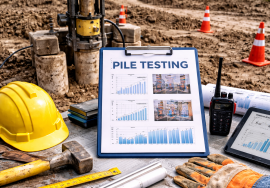

Pile Testing: Complete Guide for Construction Quality & Foundation Safety
Pile testing is a crucial process in civil engineering used to evaluate the strength, stability, and load-bearing capacity of deep foundations. Piles are long structural elements driven or drilled into the ground to transfer loads from structures to deeper, more stable soil layers. Pile testing ensures that these foundations are safe, reliable, and capable of supporting buildings, bridges, and other infrastructure projects. In a rapidly developing country like India, pile testing plays a vital role in ensuring structural safety and compliance with engineering standards.
What is Pile Testing?
Pile testing refers to a set of methods used to assess the performance and integrity of piles. These tests help engineers determine whether the installed piles can safely carry the intended load and meet design specifications. It is an essential quality control measure in construction projects.
Types of Pile Testing
Pile testing methods are broadly categorized into two main types:
1. Static Load Testing
This is the most reliable and commonly used method. It involves applying a load gradually to the pile and measuring its settlement.
- Vertical Load Test: Determines axial load capacity
- Lateral Load Test: Measures resistance to horizontal forces
- Pull-Out Test: Evaluates uplift resistance
Static load testing provides accurate data but can be time-consuming and costly.
2. Dynamic Load Testing
Dynamic testing involves applying a sudden load using a hammer and analyzing the pile’s response.
- Uses sensors and software for analysis
- Faster and more cost-effective than static testing
- Suitable for large-scale projects
Dynamic testing is widely used where quick results are required.
Non-Destructive Testing Methods
Non-destructive tests (NDT) assess pile integrity without causing damage:
- Pile Integrity Test (PIT): Detects cracks or defects
- Crosshole Sonic Logging (CSL): Evaluates concrete quality
- Low Strain Integrity Test: Checks continuity of piles
These methods are essential for quality assurance and detecting hidden defects.
Importance of Pile Testing
Pile testing is critical for ensuring the safety and durability of structures:
1. Ensures Structural Safety
Confirms that piles can support the designed loads.
2. Verifies Design Assumptions
Validates soil conditions and engineering calculations.
3. Detects Defects Early
Identifies issues like cracks, voids, or weak zones.
4. Prevents Structural Failures
Reduces risk of collapse or settlement.
5. Compliance with Standards
Ensures adherence to building codes and regulations.
Equipment Used in Pile Testing
Pile testing requires specialized equipment, including:
- Hydraulic jacks
- Load cells
- Dial gauges
- Data acquisition systems
- Sensors and accelerometers
Advanced technology improves accuracy and efficiency in testing.
Procedure of Pile Testing
The pile testing process typically involves the following steps:
- Site Preparation: Clearing and leveling the area
- Pile Installation: Driving or drilling piles into the ground
- Test Setup: Installing equipment and instruments
- Load Application: Applying load gradually or dynamically
- Data Collection: Recording settlement and response
- Analysis & Reporting: Interpreting results and preparing reports
Proper execution ensures reliable results.
Applications of Pile Testing
Pile testing is widely used in various construction projects:
- High-rise buildings
- Bridges and flyovers
- Dams and ports
- Industrial structures
- Infrastructure projects
It is especially important in areas with weak or variable soil conditions.
Advantages of Pile Testing
- Ensures foundation reliability
- Improves construction quality
- Reduces risk of failure
- Optimizes design and cost
- Enhances project safety
Challenges in Pile Testing
Despite its benefits, pile testing has some challenges:
- High cost for static load tests
- Time-consuming procedures
- Requirement of skilled professionals
- Environmental and site constraints
Proper planning and expertise help overcome these challenges.
Standards and Guidelines
Pile testing in India is governed by standards such as:
- IS 2911 (Indian Standard for pile foundations)
- ASTM standards (international guidelines)
Following these standards ensures consistency and reliability.
Future Trends in Pile Testing
The field of pile testing is evolving with technology:
- Automated data analysis
- Real-time monitoring systems
- Use of AI and IoT in construction
- Advanced sensors and digital tools
These innovations are improving accuracy and reducing testing time.
Conclusion
Pile testing is an essential aspect of modern construction, ensuring the safety, stability, and longevity of structures. By verifying the load-bearing capacity and integrity of piles, engineers can prevent costly failures and ensure compliance with standards. In a growing infrastructure landscape like India, investing in proper pile testing is not just a requirement but a necessity for sustainable and safe development.