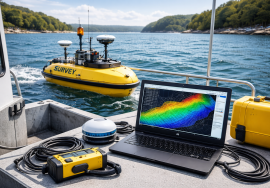

DGPS Survey in India: Precision Mapping for Modern Projects
Differential Global Positioning System (DGPS) has revolutionized the field of surveying and mapping in India, offering increased accuracy, reliability, and efficiency for a wide range of engineering, construction, infrastructure, and geospatial applications. In a country experiencing rapid urbanization, large‑scale infrastructure development, environmental monitoring, and complex transportation networks, DGPS survey technology has emerged as a cornerstone for precision mapping and geospatial data acquisition.
What is DGPS Survey?
DGPS stands for Differential Global Positioning System, an enhanced form of GPS that corrects common errors in satellite positioning. While standard GPS receivers can provide location data with an accuracy of several meters, DGPS uses a network of fixed ground reference stations to broadcast correction signals to survey receivers. These corrections minimize atmospheric, timing, and satellite orbit errors, enabling position accuracy to improve to centimeter‑level precision.
The DGPS methodology typically involves:
- A base station at a precisely known location
- A rover unit that receives both GPS signals and correction data
- Real‑time communication between base and rover to apply corrections
The result is a precision survey solution that is dependable across terrain types, climatic conditions, and project scales.
Importance of DGPS Survey in India
India’s geography is diverse — from dense urban centers to remote rural landscapes, coastal zones, river networks, and mountainous regions. This geographical diversity presents unique challenges for traditional surveying methods, which are often time‑consuming, labor‑intensive, and limited by physical accessibility. DGPS survey overcomes these limitations and offers multiple advantages:
- High Precision and Accuracy
DGPS improves positioning accuracy from meters to centimeters, making it ideal for engineering design, cadastral mapping, and alignment surveys where precision is critical. - Time and Cost Efficiency
Compared to conventional total station surveys or manual methods, DGPS significantly reduces field time and labor. Survey teams can cover large areas rapidly with fewer personnel. - Real‑Time Data Processing
DGPS enables real‑time corrections and immediate data availability, accelerating decision‑making and reducing the need for repeated field visits. - Scalability for Large Projects
Infrastructure projects such as highways, railways, pipelines, dams, and urban layouts benefit greatly from DGPS accuracy over extensive distances. - Integration with GIS and BIM
DGPS survey data integrates seamlessly with Geographic Information Systems (GIS), Building Information Modeling (BIM), and other digital platforms, supporting smart planning and digital asset management. - Reliable Across Environments
DGPS performs consistently in open areas, along coastlines, and in terrains where line‑of‑sight instruments may fail.
Applications of DGPS Survey in India
As India continues to modernize its infrastructure and enhance its technological capabilities, DGPS surveys are being applied across multiple sectors:
1. Infrastructure and Engineering Projects
DGPS plays a pivotal role in infrastructure planning and execution. For roads, bridges, expressways, and flyovers, DGPS helps in:
- Aligning centerlines and profiles
- Verifying design elevations
- Monitoring earthwork quantities
- Ensuring accurate stakeout points during construction
Large projects like the Bharatmala Pariyojana and urban expressway networks increasingly rely on DGPS for design verification and construction control.
2. Rail and Transportation Networks
Railway corridors require ultra‑precise alignment and gradient control. DGPS is used for:
- Track alignment surveys
- Platform and station design
- Overpass and underpass layout verification
- Clearance checks
In high‑speed and metro rail sectors, precision mapping accuracy is essential for safety and operational efficiency.
3. Cadastral Mapping and Land Records Modernization
One of India’s most ambitious initiatives in recent years is the Digital India Land Records Modernization Programme (DILRMP). DGPS survey contributes directly to:
- Digitizing land parcels
- Establishing accurate boundary points
- Reducing land disputes
- Updating Survey of India toposheets
Accurate cadastral surveys help secure property rights, facilitate transparent land transactions, and support urban development planning.
4. Coastal and Marine Applications
India has a long coastline with significant marine activity and port development. DGPS helps in:
- Hydrographic surveying for bathymetry
- Navigational channel mapping
- Offshore infrastructure planning
- Coastal erosion and shoreline change monitoring
These applications are vital for port security, marine infrastructure development, and coastal hazard management.
5. Environmental and Natural Resource Monitoring
Precision mapping supports environmental assessments, watershed studies, forestry management, and natural resource inventories. DGPS data feeds into GIS systems for:
- Floodplain and river network mapping
- Forest canopy and biomass monitoring
- Soil erosion assessment
- Wildlife habitat planning
6. Urban Planning and Smart Cities
DGPS enables accurate mapping for smart city initiatives, urban utility layouts, building footprints, and city asset management. Precision data ensures:
- Proper alignment of utility lines
- Mapping of underground infrastructure
- 3D city models for planning and analysis
Smart cities in India leverage precise geospatial data for traffic management, emergency response planning, and urban growth monitoring.
DGPS Workflow and Implementation
A typical DGPS survey workflow includes:
1. Pre‑Survey Planning
Surveyors identify control points, assess the site, and determine reference station locations. Planning ensures coverage and efficiency.
2. Base Station Setup
The base station is established on a known survey monument or benchmark. The GNSS receiver at the base logs raw data and broadcasts correction signals.
3. Rover Data Collection
Field teams carry rover units to collect measured positions across the target area. The rover receives both satellite signals and correction data from the base.
4. Data Processing
Real‑time kinematic (RTK) or post‑processing methods are used to compute corrected positions. Software tools refine and export the final survey data.
5. Quality Control and Verification
Survey results are checked for accuracy, consistency, and alignment with design criteria. Errors are verified and corrected.
6. Integration and Deliverables
DGPS data is integrated with CAD designs, GIS maps, and BIM models. Deliverables include highly accurate maps, topographic layers, control networks, and survey reports.
Challenges and Considerations
While DGPS is highly effective, some challenges remain:
- Signal Obstruction: Urban canyons, dense foliage, and tall structures can disrupt satellite signals.
- Baseline Distance: Accuracy decreases over long distances between base and rover without network correction systems.
- Power and Communication Needs: DGPS systems require reliable data links, power, and technical support.
- Skill and Training: Effective implementation demands trained surveyors and technicians who understand GNSS data processing and quality control.
To address these challenges, many Indian agencies adopt Continuously Operating Reference Stations (CORS) and integrate DGPS with Real‑Time Kinematic (RTK) networks to achieve high precision consistently.
Future of DGPS and Geospatial Technology in India
The role of DGPS in India is expected to grow as geospatial data becomes central to national development and smart technologies. Convergence with satellite‑based augmentation systems like GAGAN, enhanced GNSS constellations, and cloud‑based processing tools will further enhance positioning accuracy and accessibility.
India’s geospatial ecosystem is evolving rapidly, supported by government policies like the Geospatial Data Policy, infrastructure investments, and digital transformation initiatives. As industries embrace precision mapping, DGPS will continue to provide the backbone for accurate spatial information required by modern engineering, planning, and scientific applications.